Stay
Visit a locality browsing the menu on the left. In each Italy area you can then choose the best touristical structures we are proposing.
Most viewed in
Italy
-
Sunland since 1979 is the leading tour operator for ground hanling services on Amalfi Coast, Cilento and Neapolitan Riviera. Sunland is the partner of some of the biggest tour operator world wide. Our attentive staff is at your service for: Hotel accomodation...
-
The Amalfi Coast, suspended between sea and Sky, is a land of an amazing beauty. Our wish, having the pleasure to be your driver/guide, is to share with you the traditions, art, history, landscapes and the beauty that makes this land, " The Divine Amalfi...
-
Self-catering villas and apartments on the Amalfi Coast with pool, access to the sea and air conditioning. Amalfi Vacation owns and manages all the Amalfi Coast villas shown on the website. We are specialists in luxury villas and self-catering apartments...
-
Located on the famous AmalfiCoast drive, a few minutes from the famous town of Amalfi, the Santa Caterina enjoys a panoramic coastal setting of incomparable beauty. The history of this special resort is as impressive as its surroundings. In 1880, Giuseppe...
-
Situated on the last bend of Amalfi's promenade and beach, this hotel is on four levels. Bright and Mediterranean in style, the Marina Riviera is a converted old noble villa. All rooms are spacious & tastefully furnished, and have open windows or balconies...
Print this page
Send to a friend by e-mail
Colosseum
-
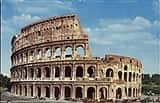
The emperors of the Flavia family built this large amphitheater for gladiatorial shows and hunts of wild animals, which in the following centuries became the symbol of the Eternal City. The building, called Colosseum starting from the Middle Ages perhaps due to the vicinity of an enormous statue of Nero (Colossus), rose on the area covered by the artificial lake of the Domus Aurea.
The works started under Vespasian and were terminated in the year 80 A.D. by Titus that promoted a magnificent inauguration with games that lasted apparently one hundred days, during which five thousand beasts were killed. The construction was completed under Domitian (81-96).
The building has an elliptical plan and consists externally of a triple series of eighty travertine arches lined by Tuscanic semicolons in the first order, Ionic in the second and Corinthian in the third. We can still see on the top the shelves and the holes for the poles that sustained the large curtain that protected the spectators from the sun and the rain. Instead the numerous holes visible all over the outside surface were made during the Middle Ages with the purpose of recuperating the metal plates that kept the stone blocks together.
The arches on the ground floor gave access to the steps and stands for the public. Above the arches the Roman numbers that indicated the various sectors of the cavea are still visible. Only the main entrances, situated in correspondence of the main axes, were not numbered because reserved to privileged categories: magistrates, vestals, religious colleges, etc.. The northern entrance lead to the tribune reserved to the Emperor.
The underground basements where used to keep the machinery and the cages for the beasts, or as storage and service rooms. They are still visible today at the center of the amphitheater, but were originally covered with wooden boards that formed the surface of the arena. Four corridors located under the main entrances connected the basements with the outside: one led to the Ludus Magnus, the main barracks of the gladiators.
The shows were free of charge and the seats were assigned according to the class of belonging: some stands in the lower sector that were reserved to the senators bear inscriptions with the names of 195 personalities of the senatorial order belonging to the period of Odoacer (476-483). The gladiatorial games were definitively forbidden by Valentinian the Third after the year 438 A.D., while the shows with hunts of wild beasts continued until 523.
In the Middle Ages the Colosseum was transformed into a fortress that belonged firstly to the Frangipane and then to the Annibaldi family. After becoming a quarry of construction material and being unceasingly dispoliated for centuries, in 1749 it was consecrated by Benedict the Fourteenth to the Passion of Jesus and "reutilized" as a monumental Via Crucis.
At the beginning of the nineteenth century the first interventions to statically reinforce the structure were performed and the large brick walls that still retain what remains of the external perimeter were built.
www.turismoroma.it